
Anchoring a trampoline for Texas wind
A trampoline is a sail on legs, and North Texas clay changes its grip on an anchor from one season to the next.
- Written for North Texas yards
- 5.0 from 237 Google reviews
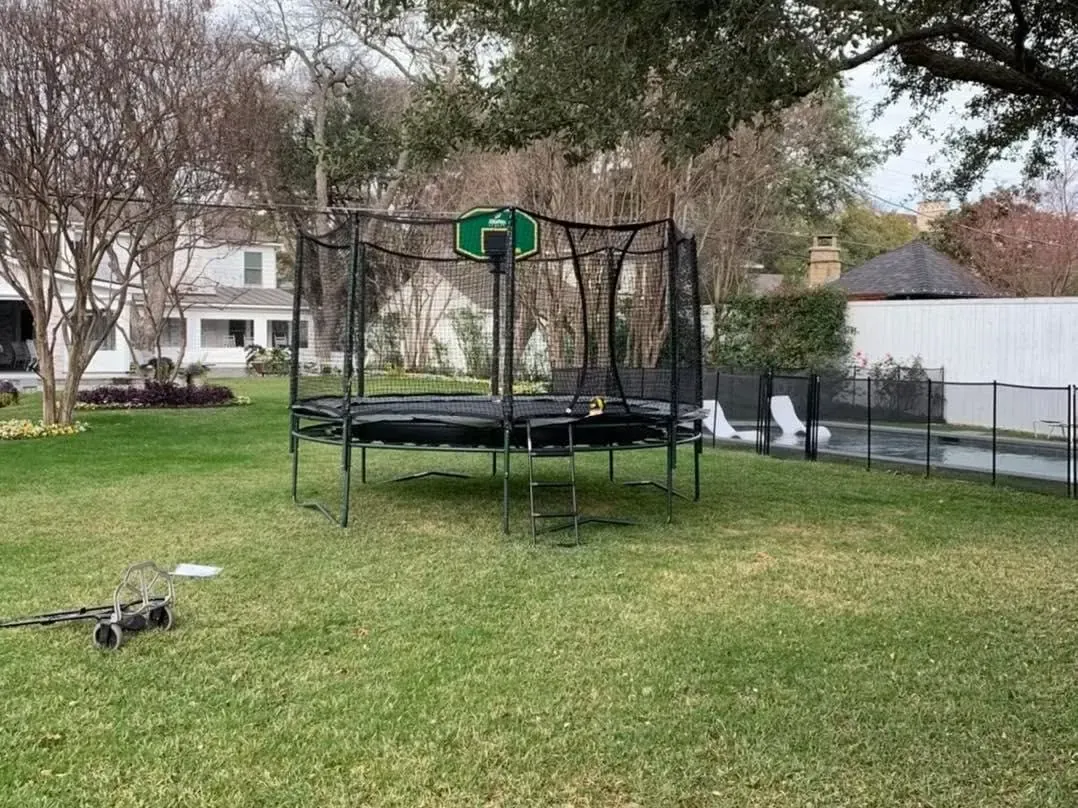
To anchor a trampoline for Texas wind, screw four steel coil anchors into the ground around the frame and run a strap from each one over the top rail, pulled tight. Check the straps after a soaking rain and every long dry spell, because clay shrinks away from an anchor. Take the net down before a severe storm. Or my crew fits four anchors for $75.
- 58 mphthe wind speed at which the National Weather Service calls a thunderstorm severe
- $75four steel coil anchors with straps, on a new build or a trampoline that is already up
- 175 lb or 450 lbwhat two trampolines of a similar size can weigh, and the light one leaves first
How to anchor a trampoline, step by step
This is the method for screw-in coil anchors with straps on a lawn. Read the manual for your own trampoline and kit too, since the maker may want the strap in a particular place.
Know what is under the grass
Find the sprinkler lines before you screw steel into the yard. Texas law requires a free 811 locate request for any digging deeper than 16 inches, and the Railroad Commission of Texas recommends one at any depth.
Park the trampoline where it will live
Set it level in its final spot first. Anchors go in around the frame as it sits, and moving it afterwards means starting over.
Mark four points
Space them evenly around the frame so no side can lift before the others. On a rectangle that is one near each corner.
Screw each coil in all the way
Turn it down until only the eye is above the grass. A coil left half out has half the dirt holding it, and the mower will find it.
Run the strap over the top rail
On most trampolines the legs only slip into sockets on the frame. A strap around a leg holds the leg while the top half lifts off and leaves, so the strap has to go over the rail that carries the springs.
Tighten in opposite pairs
Pull one strap snug, then the one across from it, then the other two. Stop when there is no slack. The strap should hold the frame down without bending it.
Pull on them again later
Check after the first soaking rain, after any long dry spell and before every front. A strap you can lift with one finger is doing nothing.
Before a storm
Do this the afternoon before, in daylight, while it is still calm.
- Pull on every strap and take up any slack
- Look at the dirt around each anchor. A gap you can see means the clay has shrunk away from it
- Drop or unclip the enclosure net if your model allows it
- Take off shade tops, tent covers and weather covers
- Bring in the ladder, the basketball goal and loose toys
- If it is not anchored, strap the top rail to something fixed in the ground, or get it into a sheltered corner
- Keep kids off it until the storm has passed and you have checked the frame
Rather not do it yourself? Text me a photo and I'll text back a firm price.
Why a trampoline flies
Wind does not push a trampoline over. It lifts it. The jumping mat is a solid sheet 12 to 15 feet across, held about waist high, and a gust that gets under it has the whole underside to work on. The net on top stands taller than a six-foot fence, so it catches wind the fence never slows down. Nothing else in the yard has that much sail.
Until it is anchored, only weight holds it. A cheap 14 or 15 ft trampoline weighs under 200 lb. A premium one the same size can weigh 400 to 500 lb. As I have put it before, a 500 lb trampoline is a whole lot harder for Mother Nature to relocate than a 150 lb one, and I would still anchor both.
Where it sits matters as much as what it weighs. One surrounded by fences, tall homes and trees is less likely to be damaged than one in an open field or by a lake. I recommend anchoring either way.
The National Weather Service calls a thunderstorm severe when its wind reaches 58 mph, and its severe thunderstorm watches tell people to secure outdoor items that could blow around. The storms that came through at sunrise on 28 May 2024 flipped a trampoline into a backyard in Mesquite, and CBS News Texas ran the photo that morning.
Anchors, and what each one holds in clay
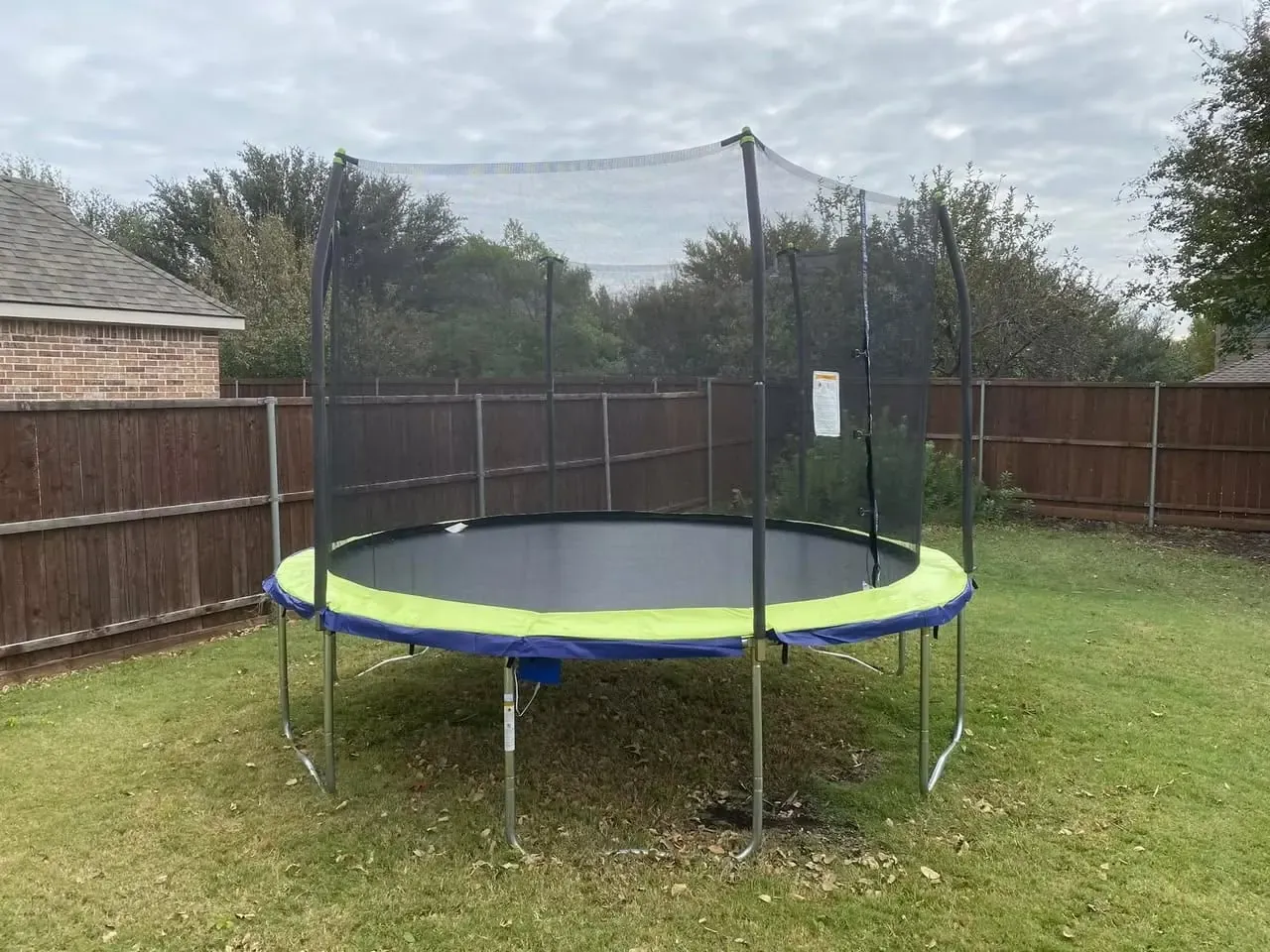
Four things are sold for holding a trampoline down. Wind stakes are U-shaped rods that push straight into the ground over a leg. Peg anchors do the same with more steel: the kit Springfree sells for its own trampolines is four anchors that sit over the legs, pegged in with a rubber mallet. Coil anchors screw into the dirt like a corkscrew and tie to the frame with a strap. Sandbags sit on the legs.
Clay sorts them out. The USDA soil sheet for Houston Black, the Blackland Prairie clay, says it cracks half an inch to 4 inches wide and a foot deep or more when it dries. A smooth stake beside one of those cracks is standing in a slot. Soak the same clay in spring and a stake pushed in by hand comes out by hand.
A coil has to unscrew to come out, and wind does not unscrew things. That is why I use them. Clay still gets a vote. When it shrinks, the strap goes slack even though the coil has not moved, and a slack strap lets the frame get a running start. Springfree says the same of its own anchors, that soil conditions change over time and anchors need inspecting. Sandbags are for patios, where nothing can be screwed in. They add weight and tie the trampoline to nothing.
When a storm is in the forecast
The checklist above takes ten minutes. The net matters most, since it is the tallest thing on the trampoline and the easiest to take away from the wind. Tight, solid-looking netting catches more than an open weave. If yours unclips or slides down the poles, drop it.
An unanchored trampoline the night before a storm is a harder problem. Springfree gives three options for severe weather: lower the enclosure, move the trampoline somewhere sheltered, or take it apart. As a stopgap, strap the top rail to something fixed in the ground. Doing that before every front gets old, which is the argument for anchoring it once.
After one has blown over
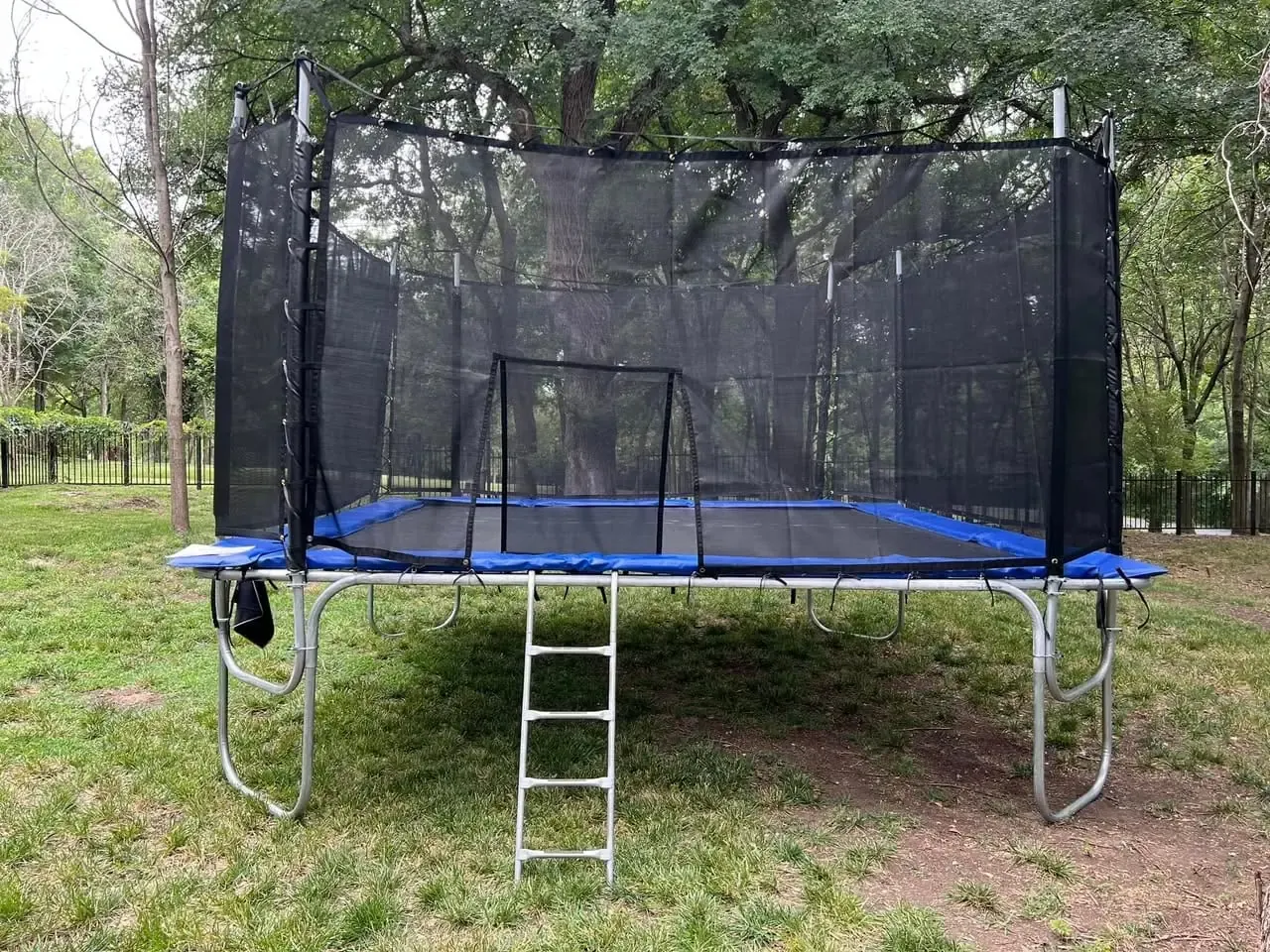
Stay away from it if it is touching a power line or hung in a tree, and call the electric company for the first one. A trampoline in a tree, on a roof or in a pool is usually work for an arborist, a roofer or a pool company, and I will tell you straight if it is not a job for my crew. Otherwise, photograph it where it landed, and any fence, roof or car it touched, before anyone moves it. Your insurer will ask for those photos, and what your policy covers is a question for your agent.
Then look at what bent. Legs, net poles and the net take most of the damage, and on a good frame all three can be replaced. The top ring decides it. Stand the trampoline on flat ground: if the ring rocks or sits twisted, the frame has folded and I would not put a child on it. Check the leg sockets for cracks and the springs for any that have stretched and stay open.
A trampoline that cost $1,000 or more usually has a frame worth buying parts for. A $300 one that needs legs, poles and a net is done. My crew can haul it off, but the dump means haul and dump fees, so setting the pieces at the curb for bulk trash pickup is often cheaper. Carry it back with several adults lifting at the legs, since dragging is how a straight frame gets bent.
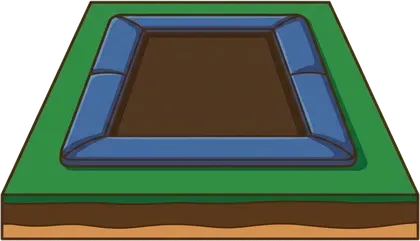
If the wind has taken more than one trampoline from your yard, price an inground one. They don't blow away in a storm, because the frame sits in a pit and the mat is level with the lawn.
Questions people ask next.
Don't see yours? Text it to me or try the full list of 60.
How many anchors does a trampoline need?
I use four coil anchors, spaced evenly around the frame, with a strap from each over the top rail. Four lets every side be held against an opposite side, tightened in opposite pairs.
Do the wind stakes that came with my trampoline hold in clay?
Push-in wind stakes hold poorly in North Texas clay. The clay cracks open when it dries and goes soft when it is soaked, and a smooth stake that pushes straight in pulls straight out in both conditions. Screw-in coil anchors with straps hold better.
How often should I check trampoline anchors?
Check the straps every few months, after any long dry spell and before every storm front. Blackland clay shrinks as it dries, so a strap that was tight in April can be loose by August. Take up the slack and look for a gap in the dirt around each anchor.
At what wind speed should I worry about my trampoline?
Treat any severe thunderstorm forecast as the trigger, because no single wind speed moves a trampoline. The National Weather Service defines severe as wind of 58 mph or more, and a light trampoline with its net up can move in less.
Will anchors keep my trampoline from blowing away?
Anchors make it far less likely, and they are not a guarantee. A strong enough storm can move an anchored trampoline, and Springfree says of its own kit that anchors are not perfect. Anchor it, check the straps and take the net down before severe weather.
Can a trampoline that blew over be repaired?
Often, yes. Bent legs, snapped net poles and a torn net can be replaced when the top ring of the frame is still flat and straight and parts for the model can still be had. A twisted ring means the trampoline should be hauled off.
Takes about a minute
Get my price
A few taps and you'll see a real number wherever I publish one. No home visit to find out.