
DIY or hire it out: how long trampoline assembly really takes
Plenty of people can build their own trampoline, and here is how, plus which ones I would not start at 4 PM on Christmas Eve.
- Written for North Texas yards
- 5.0 from 237 Google reviews
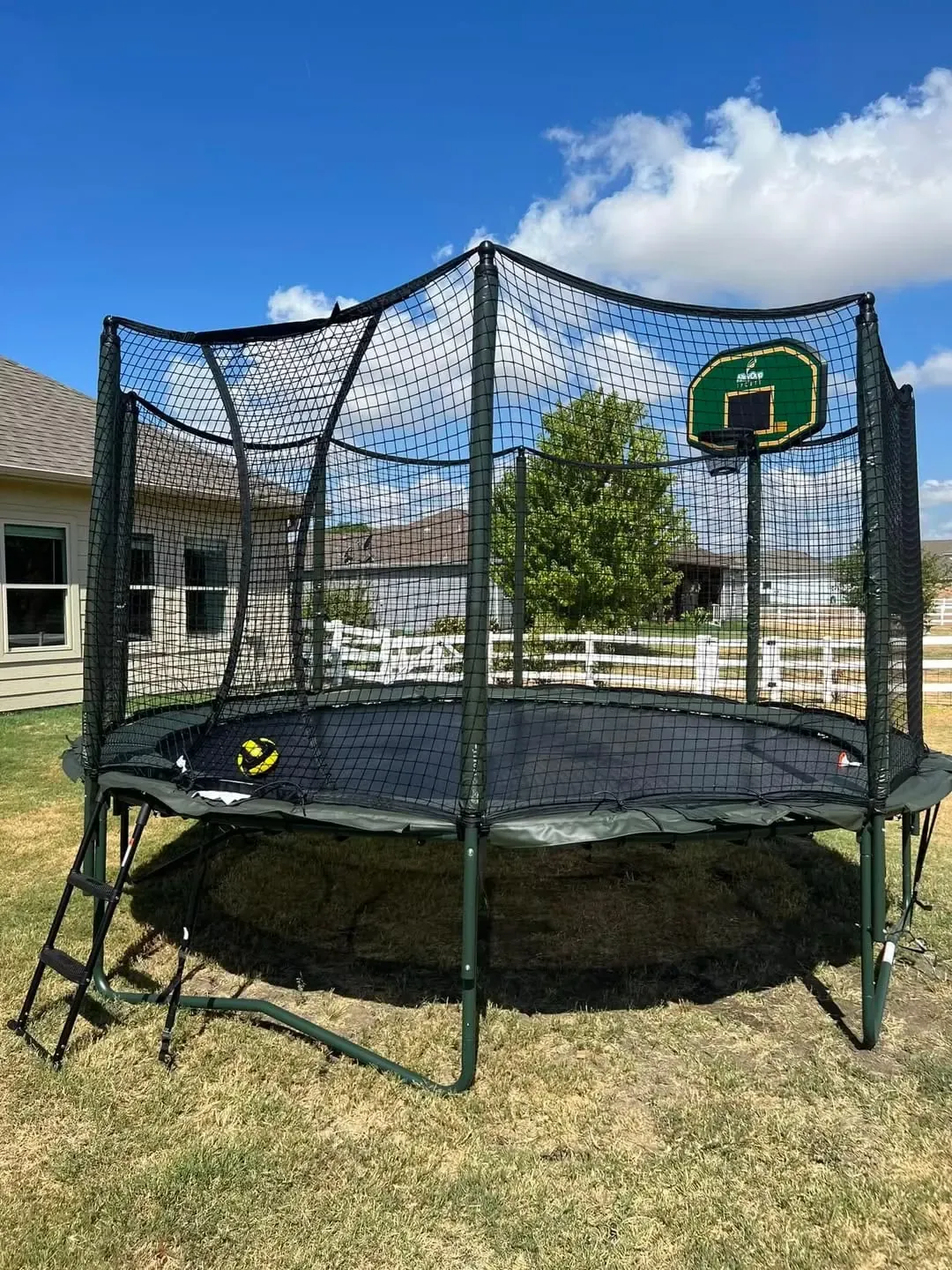
Two adults can build most round spring trampolines in an afternoon. Skywalker's manuals say to plan on at least two adults and two hours, and Springfree allows two people two to four hours for a first build. The springs and the enclosure net are where home builds stall. Or text me the brand and size: my crew assembles any brand in Dallas–Fort Worth.
- 2 adults, 2 hoursThe least Skywalker tells buyers to allow in its manuals
- 2 to 4 hoursWhat Springfree allows two people for a first build
- 2.5 hoursOne of my own builds, filmed from the first box to the last pad
What the makers say a build takes
These are the makers' own published figures, for people doing it the first time. None of them includes carrying boxes to the backyard or going to find a missing bolt.
| Trampoline | Maker's stated time | People the maker asks for |
|---|---|---|
| Skywalker Epic round, 96 springs | At least 2 hours | At least 2 adults |
| Jumpzylla rounds, 8 to 16 ft | 60 to 90 minutes | One, faster with two |
| Acon Air 15 ft round, 110 springs | About an hour, depending on team size | Not stated |
| Springfree Large Square, by its manual | Typically 2 hours | Two |
| Springfree, any model, first build | 2 to 4 hours | Two |
One build of mine that I filmed from start to finish ran two and a half hours, and I do this for a living. Treat the low end of any maker figure as a best case.
Rather not do it yourself? Text me a photo and I'll text back a firm price.
How long it really takes
The maker figures in the table are honest for what they measure: hands-on time, every part present, two people who never stop. Skywalker's own wording is that you will probably need at least two adults and two hours, depending on the model. Jumpzylla breaks its 60 to 90 minutes into steps and allows 20 minutes for all the springs and the mat.
What stretches a first build is everything around it. Boxes get carried to the backyard, and on an Acon 16 HD that means three packages of 121 to 219 lb each. Parts get sorted. The manual gets read twice. The 16 HD rectangle has 140 springs. Give a big rectangle a full day and be pleased if it takes less.
Below is my crew's time on site, by type. It counts carrying the boxes to the spot, unwrapping every part, which takes a while with makers who pack with care, and hauling the packing away when we brought the trampoline.
- A round spring trampoline: 1 to 2 hours
- A big rectangle: 2 to 4 hours
- A Springfree build: 1 to 2 hours
- A Springfree take-down: 1 to 2 hours
- An Acon X or Acon 16 HD: 3 to 6 hours
Tools and people
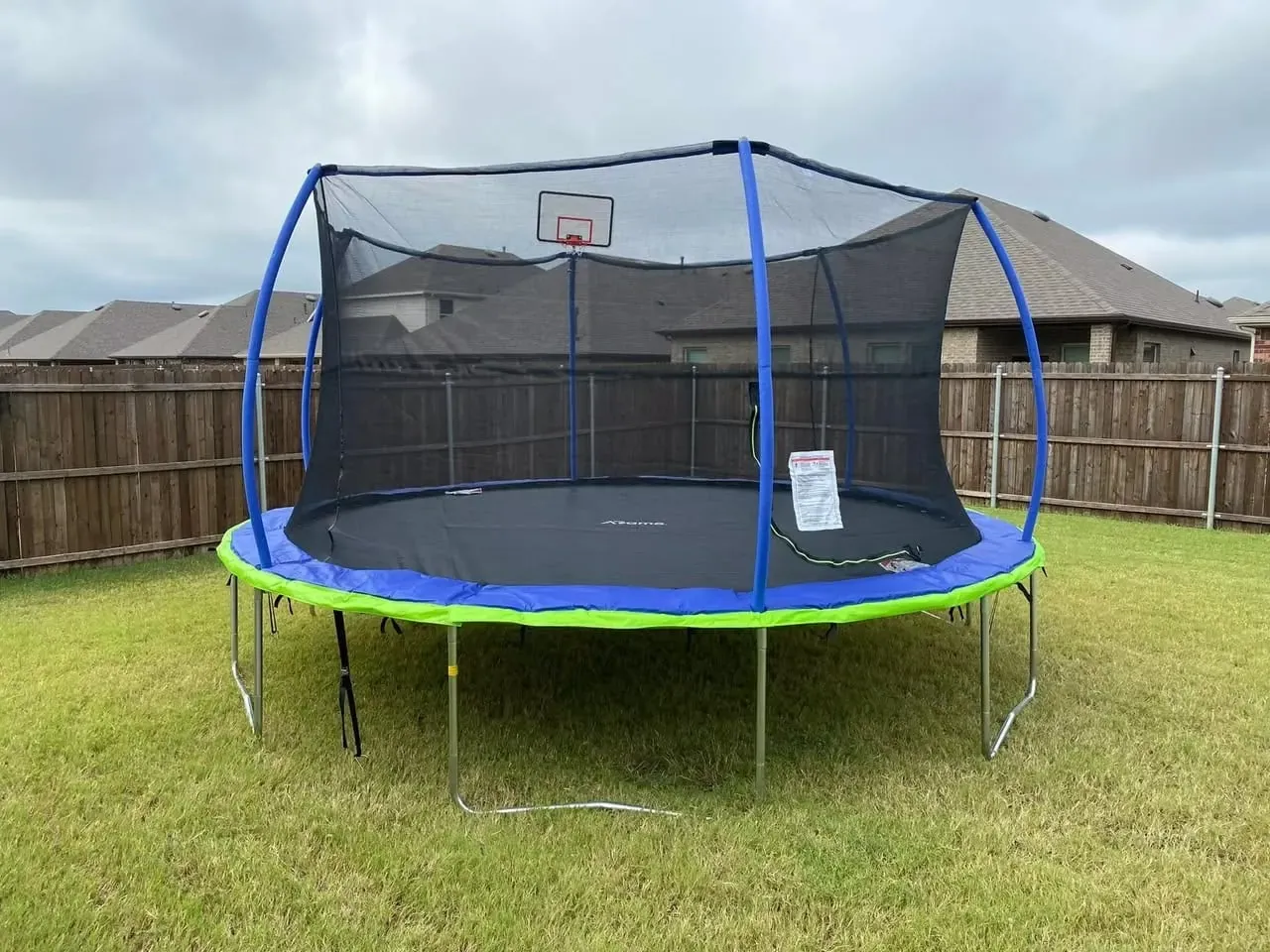
Most trampolines ship with a spring tool, a handle with a hook that pulls the spring to the frame. Skywalker, Acon, Jumpflex and Jumpzylla all put one in the box. Skywalker's manual adds that a power drill makes the job easier and tells you to wear gloves for the pinch points. I would add eye protection. A spring that slips off the tool under tension goes somewhere fast.
Two adults is the working minimum. One person can hang springs alone, and Jumpzylla says one person can do its whole build. The frame is where the second person earns their lunch, because the last sections of a ring have to be lined up and pushed home while somebody holds the far side still.
- The spring tool from the box, or a second one so two people can pull at once
- Heavy work gloves for both of you
- Safety glasses or other eye protection for whoever is pulling springs
- A drill or driver with the right bits and sockets, set to a low clutch
- A second adult for the frame, the mat and the net
- A tape measure to check clearance before the first section goes down
The four places a home build goes wrong
Spring order is the first. People start at one spring and work around the circle. The mat gets dragged to one side, and by the last third some springs will not reach their holes no matter who pulls. The fix is taking a lot of them back off.
The frame is the second. A leg that is not seated, or a top rail built on a slope, leaves the trampoline rocking, and spring tension will not pull it straight. My crew gets legs as level as the ground allows. Nobody can level a hillside.
The net is the third, and on some brands it is the hardest part of the job. I am a fan of the JumpSport Classic and I will still tell you its enclosure is extremely tough to assemble properly. Skywalker's rectangles have a socket and bolts at every leg and pole joint, and that pile of hardware wears people out.
The fourth is a Springfree, its own category. There are no springs. Fiberglass rods get flexed into the mat one at a time, and Springfree's manual says both people must keep a steady grip on a rod until it is seated. It warns you to keep your face well away from any loaded rod, because one that releases can cause facial injury or blindness, and to keep small children at least 25 ft away during assembly. Leave the printed sequence and the mat becomes very difficult to attach.
When to build it yourself, and when to hire it out
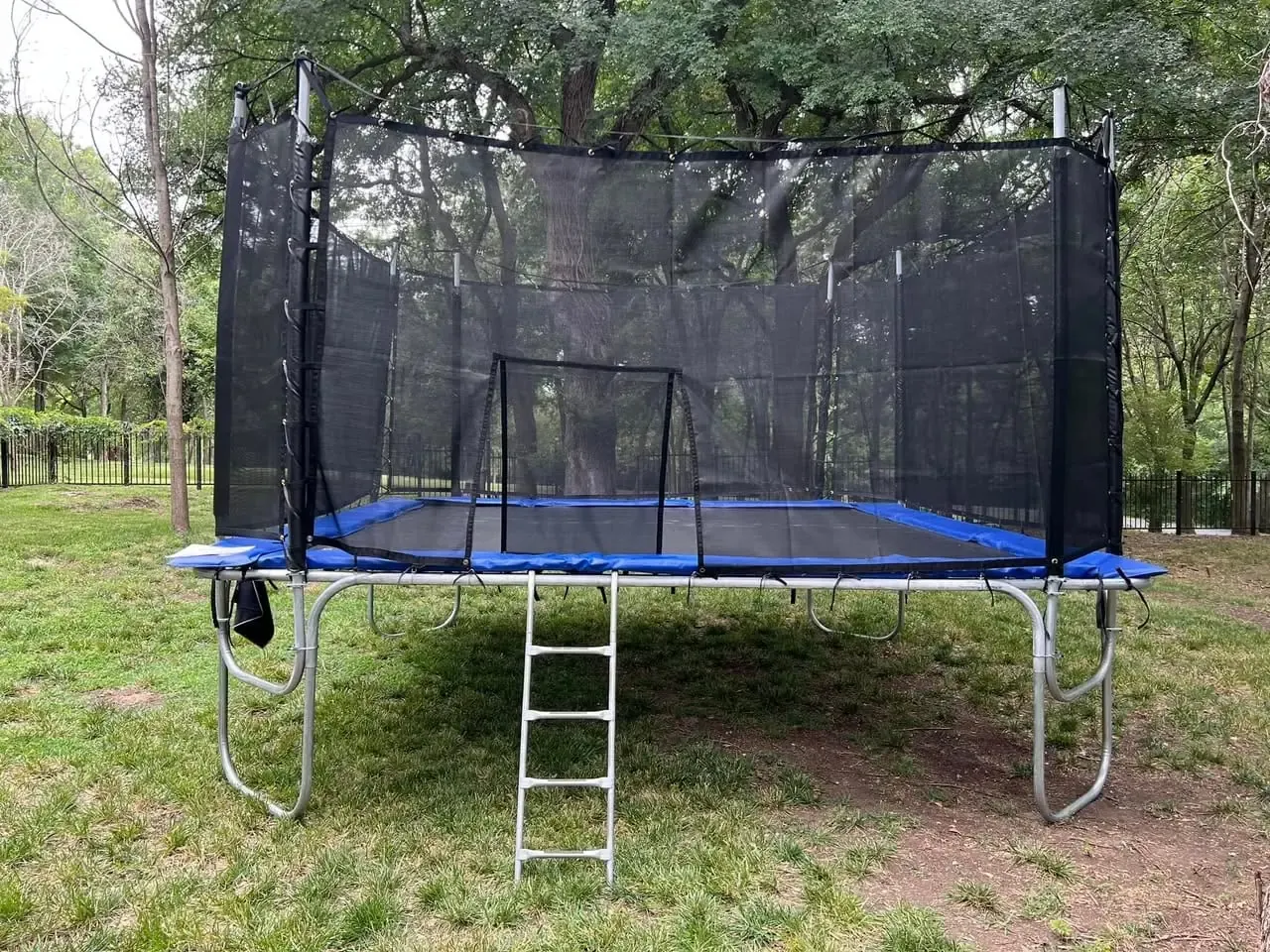
Build it yourself when it is a round with a net, every box arrived sealed, you have a free afternoon and a second adult, and nothing depends on the date. Getting stuck is no disgrace. A 10-year-old named Cam once FaceTimed me to come and fix the trampoline he had started on his own. He watched me put it right, and when his grandmother paid me in $20 bills I handed one to Cam.
If you buy from me, the put-it-together-yourself price shows what the labor is worth on that model. An Acon Air 15 ft is $1,399 delivered or $1,749 built. A JumpKing 15 ft is $599 delivered or $899 built.
Hire it out when the date cannot move, when it is a Springfree or a big rectangle, when it is a used trampoline that came apart at another family's house without its manual, or when the spot is not flat. Christmas is the obvious one. My Christmas week fills early and costs more each day closer to Christmas Eve.
The jobs this guide covers.
Questions people ask next.
Don't see yours? Text it to me or try the full list of 60.
How long does it take to put a trampoline together yourself?
Plan on an afternoon for a round with a net and a full day for a big rectangle. Skywalker says to allow at least two adults and two hours, and Springfree allows two people two to four hours for a first build. Both assume every part is there.
Can one person assemble a trampoline?
Sometimes. Jumpzylla says one person can handle its full assembly, while Skywalker and Springfree both ask for two. In practice one person can hang springs, and joining the frame, lifting the mat and hanging the net go far better with a second adult.
What tools do I need to assemble a trampoline?
A spring tool, work gloves and eye protection, plus a drill or driver, cover nearly every spring trampoline. The spring tool is normally in the box. Skywalker supplies a screwdriver as well and says a power drill makes assembly easier.
What order do trampoline springs go on?
Opposite each other first, then filled in between. Hook a few on one side, the same number straight across, then the quarter points, counting V-rings and frame holes as you go. Skywalker warns that placing springs one directly after another causes uneven tension.
Can I build a Springfree myself?
Yes, with a second adult and the manual for your exact model. Springfree puts installation at two hours with two people, and allows two to four hours for a first build. Follow the rod sequence exactly and keep your face clear of any loaded rod.
I started building it and got stuck. Will you finish it?
Yes. Text me a photo of how far you got, the brand and size, and your zip code. I will price what is left, which sometimes includes taking springs back off to start the pattern again.
Takes about a minute
Get my price
A few taps and you'll see a real number wherever I publish one. No home visit to find out.